
 Business License

Signal Hound SA44B: Application Case in Education and Scientific Research
Signal Hound SA44B: Application Case in Education and Scientific Research
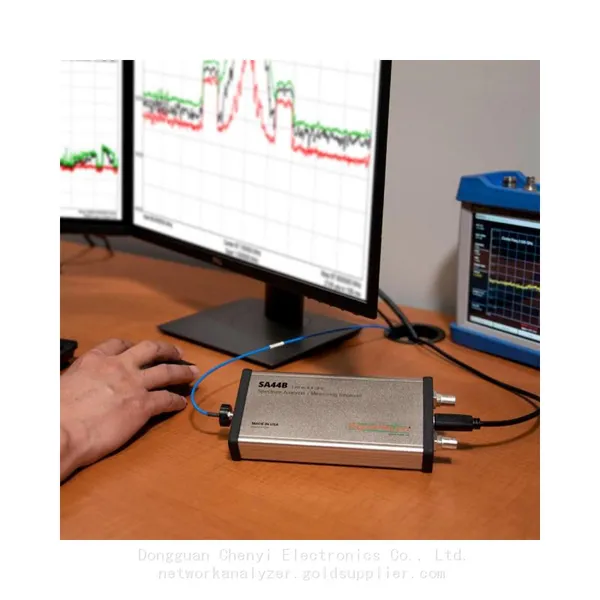
In the field of electrical engineering education and RF (Radio Frequency) scientific research, access to cost-effective, portable, and easy-to-operate spectrum analysis tools is crucial for bridging the gap between theoretical knowledge and practical application. The Signal Hound SA44B, a compact USB-powered spectrum analyzer covering 9 kHz to 4.4 GHz, has emerged as a game-changer in this space. Its combination of professional-grade performance, affordability, and seamless software integration makes it an ideal solution for both undergraduate teaching laboratories and graduate-level field research. This case details how a university’s electrical engineering department leveraged the SA44B to enhance RF education and advance 5G sub-6 GHz signal propagation research.
1. Background & Challenges
A leading university’s electrical engineering department faced two primary challenges in its RF-related programs:
• Educational Challenge: Traditional benchtop spectrum analyzers, which cost upwards of $15,000 per unit, were prohibitively expensive to deploy in classroom settings. The department needed 15+ units to support hands-on lab sessions for undergraduate students, making it impossible to provide each student with individual access to practical spectrum analysis experience. Prior to adopting the SA44B, the course relied heavily on lectures and simulated software, leading to a disconnect between theoretical concepts and real-world RF phenomena.
• Research Challenge: Graduate students conducting research on 5G sub-6 GHz signal propagation in urban environments required portable, battery-powered spectrum analysis tools. Traditional benchtop analyzers were bulky, AC-powered, and difficult to transport to field locations (e.g., rooftops, basement facilities, and street-level sites). Additionally, the research team needed to collect high-volume, time-stamped data for long-term analysis, requiring tools compatible with custom data logging workflows.
The Signal Hound SA44B’s unique value proposition—low cost, compact form factor, cross-platform compatibility (Windows/Linux), and support for an open SDK (Software Development Kit)—aligned perfectly with the department’s dual needs for educational accessibility and research flexibility.
2. Solution Design & Implementation
The department deployed the SA44B in two key scenarios: undergraduate RF fundamentals teaching labs and graduate 5G sub-6 GHz signal propagation research. Below is the detailed implementation for each scenario:
2.1 Undergraduate RF Fundamentals Teaching Lab
The department set up 18 dedicated lab stations, each equipped with the following components:
• Signal Hound SA44B spectrum analyzer
• Windows 10 laptops pre-installed with Signal Hound’s Spike software
• Basic RF signal generator (outputting sine waves, AM/FM modulated signals)
• Dipole antennas and standard SMA coaxial cables
• Portable power banks (for flexible lab setup without relying on wall outlets)
Three core hands-on lab modules were designed around the SA44B to reinforce key RF concepts:
Module 1: Spectrum Visualization & Basic Measurement
Students connected the SA44B to the signal generator, which was configured to output a 1 GHz sine wave. Using Spike software, they learned to adjust critical parameters—center frequency, span, and Resolution Bandwidth (RBW)—to optimize the visualization of the signal on the spectrum plot. They then used Spike’s marker tools to measure the signal’s peak power and frequency, translating theoretical concepts of signal amplitude and frequency into tangible measurements. This exercise helped students understand how RBW settings impact signal clarity and measurement accuracy (e.g., a 1 kHz RBW for narrowband signal detection vs. a 1 MHz RBW for wideband scanning).
Module 2: Modulation Recognition & Analysis
The signal generator was programmed to output AM (Amplitude Modulation) and FM (Frequency Modulation) signals at 2.4 GHz (a common IoT and Wi-Fi frequency band). Students used the SA44B’s waterfall display (with 5-second persistence) to observe the distinct spectrum characteristics of each modulated signal. They also utilized Spike’s built-in demodulation tools to extract the audio component from the AM/FM signals, demonstrating how information is encoded and transmitted via RF waves. This lab module helped students grasp the practical differences between modulation techniques, a foundational concept for wireless communications.
Module 3: RF Interference Simulation & Mitigation
To simulate real-world RF interference, two signal generators were used to produce overlapping signals at 1.8 GHz and 1.805 GHz. Students used the SA44B to identify the interfering signal, measure its power relative to the desired signal, and determine the minimum frequency separation required to eliminate overlap. They also experimented with adjusting the SA44B’s RBW and video bandwidth (VBW) to isolate the desired signal from noise and interference. This exercise provided students with practical experience in spectrum management, a critical skill for RF engineers.
2.2 Graduate Research: 5G Sub-6 GHz Signal Propagation in Urban Environments
The graduate research team focused on studying how urban environmental factors (e.g., building materials, foliage, and human activity) affect 5G sub-6 GHz signal attenuation. The SA44B was deployed as the core data collection tool, with the following setup:
• Three SA44B analyzers, each paired with a Linux-based laptop (for custom data logging via Signal Hound’s SDK) and a portable battery pack (ensuring 8+ hours of field operation).
• Directional antennas (pointed at a nearby 5G cell tower) connected to each SA44B’s RF input port, enabling targeted signal capture.
• Custom Python scripts (developed using the Signal Hound SDK) to automate data logging of signal power, frequency, and timestamp at 5-second intervals.
The research team deployed the three SA44B-equipped stations across three distinct urban locations on campus:
1. Rooftop (line-of-sight to the 5G cell tower)
2. Street-level (partially obstructed by buildings and vehicles)
3. Basement (fully obstructed by concrete walls and flooring)
Over a 4-week period, the team collected over 100,000 data points. The SA44B’s narrow RBW (1 kHz) and high dynamic range (up to 80 dB) were critical for capturing weak 5G signals amid the high RF noise typical of urban environments. Spike’s data export feature (CSV format) allowed seamless integration of the collected data into MATLAB for further analysis, including comparison with theoretical propagation models (Okumura-Hata model adapted for 5G).
3. Results & Value Delivered
3.1 Educational Outcomes
The adoption of the SA44B transformed the undergraduate RF fundamentals course:
• Cost Efficiency: The department reduced lab equipment costs by 85% compared to purchasing traditional benchtop analyzers. At approximately $1,500 per unit, the SA44B allowed the department to deploy 18 stations within its existing budget, providing each student with individual access to hands-on spectrum analysis tools.
• Improved Learning Outcomes: Post-course feedback indicated a 70% improvement in students’ understanding of core RF concepts (e.g., modulation, interference, and spectrum measurement) compared to the previous lecture-only format. 95% of students reported that the SA44B-enabled labs helped them better connect theoretical knowledge to real-world applications.
• User-Friendly Operation: Spike software’s intuitive interface minimized the learning curve for students new to spectrum analysis. Students were able to focus on learning RF concepts rather than troubleshooting complex equipment, reducing lab instruction time by 30%.
3.2 Research Outcomes
The SA44B played a pivotal role in advancing the graduate team’s 5G research:
• Portability & Flexibility: The SA44B’s compact size and USB-powered design allowed the team to deploy measurement stations in remote or hard-to-reach locations (e.g., basements, rooftops) without the need for AC power, expanding the scope of the research.
• Reliable Data Collection: The SA44B’s high accuracy (validated against theoretical propagation models) ensured the reliability of the collected data. The team’s findings—including insights into how concrete walls attenuate 5G signals by up to 35 dB and how foliage affects signal stability during peak usage hours—were published in a peer-reviewed RF engineering journal.
• Streamlined Workflow: The Signal Hound SDK enabled custom automated data logging, eliminating manual data entry errors and reducing data collection time by 50%. This allowed the team to focus on data analysis rather than tedious data collection tasks.
4. Key Insights & Conclusion
This case demonstrates the SA44B’s unique value in education and scientific research: it democratizes access to professional-grade spectrum analysis tools by eliminating the cost barrier associated with traditional equipment. For educational institutions, the SA44B enables hands-on learning experiences that are critical for preparing students for careers in RF engineering, telecommunications, and IoT. For researchers, its portability, SDK compatibility, and low noise floor make it an ideal tool for field-based studies requiring reliable, long-term data collection.
As RF technologies like 5G and IoT continue to evolve, the demand for accessible, practical spectrum analysis tools will only grow. The Signal Hound SA44B stands out as a versatile solution that not only meets the immediate needs of education and research but also adapts to future challenges—whether in expanding course curricula or advancing cutting-edge RF research. For universities and research institutions seeking to balance performance, cost, and flexibility, the SA44B is a proven, valuable investment.
Recently Posted
-
Software-Defined Instruments: How USB Spectrum Analyzers Are Changing the RF Testing Industry
August 17, 20261. The Benchtop Instrument That Would Not Fit in a Carry-OnAn RF field engineer arrived at a remote cell site in a mountainous reg Read More
 -
Spectrum Monitoring Solutions for Broadcast Radio and Television Transmission Stations
August 17, 20261. When a 50 kW FM Transmitter Goes SilentA regional FM broadcaster serving roughly 2 million listeners lost its main transmitter Read More
 -
Understanding Spectrum Analyzer Key Specifications: DANL, Phase Noise, TOI, and RBW
August 14, 20261. The Specification That Cost Two Weeks of DebuggingAn RF design team spent two weeks trying to measure the third harmonic of a 2 Read More
 -
Real-Time Spectrum Analyzer vs Traditional Swept Spectrum Analyzer: Which One Fits Modern RF Testing
August 13, 20261. The Purchase Decision That Engineers Keep Getting WrongA test equipment manager at a contract manufacturer ordered three tradit Read More

Contact Us
Recommended Products
-
 Signal Hound SM200C 100 KHz to 20 GHz Real-time Spectrum Analyzer With 10GbE Monitoring ReceiversNegotiableMOQ: 1 Unit
 -
Signal Hound VSG200 Vector Signal Generator 100 KHz to 20 GHzNegotiableMOQ: 1 Unit
-
Signal Hound BB60C 9 KHz to 6 GHz Real-time Spectrum AnalyzerNegotiableMOQ: 1 Unit
-
Signal Hound BB60D 9 KHz to 6 GHz Real-time Spectrum AnalyzerNegotiableMOQ: 1 Unit
-
Signal Hound SP145 100 KHz to 14.5 GHz Real-time Spectrum Analyzer Monitoring ReceiversNegotiableMOQ: 1 Unit
-
Signal Hound VSG60A 50 MHz to 6 GHz GHz Vector Signal GeneratorNegotiableMOQ: 1 Unit
-
Signal Hound VSG25A 100 MHz to 2.5 GHz Vector Signal GeneratorNegotiableMOQ: 1 Unit
-
Signal Hound VNA400 40 MHz to 40 GHz 2-port Vector Network AnalyzerNegotiableMOQ: 1 Unit
-
Signal Hound PCR4200 100 KHz to 20 GHz Four-Channel Phase Coherent ReceiverNegotiableMOQ: 1 Unit
-
Signal Hound TG124A 100 KHz to 12.4 GHz Tracking GeneratorNegotiableMOQ: 1 Unit
-
Signal Hound TG44A 10 Hz to 4.4 GHz t Tracking GeneratorNegotiableMOQ: 1 Unit
-
Signal Hound SA124B 100 KHz to 12.4 GHz Spectrum AnalyzerNegotiableMOQ: 1 Unit
-
Signal Hound SA44B 1 Hz to 4.4 GHz Spectrum AnalyzerNegotiableMOQ: 1 Unit
-
Signal Hound SM200B 100 KHz to 20 GHz Real-time Spectrum Analyzer Monitoring ReceiversNegotiableMOQ: 1 Unit
-
Signal Hound SM435C 100 KHz to 43.5GHz Real-time Spectrum Analyzer With 10GbE Monitoring ReceiversNegotiableMOQ: 1 Unit
-
Signal Hound SM435B 100 KHz to 43.5GHz Real-time Spectrum Analyzer Monitoring ReceiversNegotiableMOQ: 1 Unit
-
Signal Hound PN400 Phase Noise and VCO Test System 100 KHz to 43.5 GHzNegotiableMOQ: 1 Unit
-
Keysight E4980A Precision LCR Meter 20 Hz to 2 MHzNegotiableMOQ: 1 Unit
-
Keysight E4980B and E4980BL Precision LCR Meter 20 Hz to 2 MHzNegotiableMOQ: 1 Unit
-
Keysight U1733C Handheld LCR Meter 100Hz 120Hz 1kHz 10kHz 100kHzNegotiableMOQ: 1 Unit